For decades, computing maintained an unbending boundary: software engineers write deterministic code, while numeric optimization algorithms write neural network weights.
In 2017, Andrej Karpathy framed this in Software 2.0. In Software 1.0, engineers wrote explicit algorithms using loops and branching logic. In Software 2.0, engineers specified datasets and loss functions, delegating parameter optimization to gradient descent and backpropagation. To programmers, the resulting floating-point tensors remained an opaque soup of continuous numbers. We could train them, quantize them, and prune them, but we could not read them or edit them directly with semantic intent.
A paper from MIT CSAIL—authored by Rikiya Takehi, Jayden Teoh, Alex Zhang, and Omar Khattab—has shattered that assumption.
The researchers demonstrated that frontier Large Language Models (LLMs), led by OpenAI's GPT-6 Astra and verified on open models like Qwen 3.8 27B, possess an emergent capacity to interpret, synthesize, and edit raw neural network weights. Without writing training loops, computing loss gradients, or executing backpropagation, these models can inspect raw weight arrays, deduce what task an unknown network was trained to execute, synthesize working policies zero-shot that outplay reinforcement learning baselines trained for 100 million steps, and perform surgical tensor modifications that resolve pathological reasoning loops in language models.
This paradigm is called Weight-Space Programming. It represents the early architecture of Software 3.0: intelligence runtimes treating neural parameters as readable, editable, and compilable software.
Throughout deep learning, we encoded simplistic inductive biases into tiny symbolic optimizers like Adam or Muon. Weight-Space Programming proves that frontier reasoning models can bypass the gradient entirely, treating continuous tensor matrices as readable code.

To appreciate why reading neural weights is a profound conceptual shift, consider what a weight tensor looks like on disk. It is a dense serialization of IEEE 754 floating-point values—hundreds of thousands of numbers like -0.04128, 0.89201, and 0.00145. Inspecting a raw PyTorch state dictionary provides zero semantic clues regarding whether the network classifies digits, steers a vehicle, or drafts prose.
The MIT CSAIL team subjected GPT-6 Astra to blind experiments to test whether an LLM could reverse-engineer behavior purely from static weight tensors without running a forward pass.
┌────────────────────────────────────────────────────────────────────────┐
│             THE WEIGHT-SPACE READING PARADIGM (MIT CSAIL)              │
│                                                                        │
│   Input: Raw Weight Tensors (IEEE 754 Floats, No Environment Context)  │
│   [ -0.0412,  0.8920,  0.0014, -0.3129,  0.1182,  0.0543, ... ]        │
│                                  │                                     │
│                                  ▼                                     │
│   ┌────────────────────────────────────────────────────────────────┐   │
│   │               Frontier LLM (e.g., GPT-6 Astra)                 │   │
│   │    - Inspects weight concentration geometry                    │   │
│   │    - Factorizes W_Q · W_K^T projection matrices                │   │
│   │    - Identifies circuit topology and behavioral invariants     │   │
│   └──────────────────────────────┬─────────────────────────────────┘   │
│                                  │                                     │
│                                  ▼                                     │
│   Deductions:                                                          │
│   - "Trained on Atari Breakout (paddle weights concentrate on row 10)" │
│   - "Induction heads located at layers [2.1, 3.1, 3.5] for Python code"│
└────────────────────────────────────────────────────────────────────────┘
In their first experiment, the authors trained identical multilayer perceptrons (MLPs with architecture 500 32 32 5, containing 17,253 weights) using Proximal Policy Optimization (PPO) across four distinct 1010 grid games: Breakout, Pong, Pac-Man, and Freeway. The networks shared identical dimensions, input channels, and action spaces. When raw weight arrays were passed as plain text into Astra—with no environment feedback, no game names, and no forward executions permitted—the model accurately named the exact game each policy was trained to play.
Astra reasoned about the spatial distribution of weights in the first layer. In Breakout, weights assigned to the agent channel concentrated along the bottom row of the input grid, matching the physical topology of a paddle. The output layer weights revealed distinct logit separations corresponding to horizontal movements.
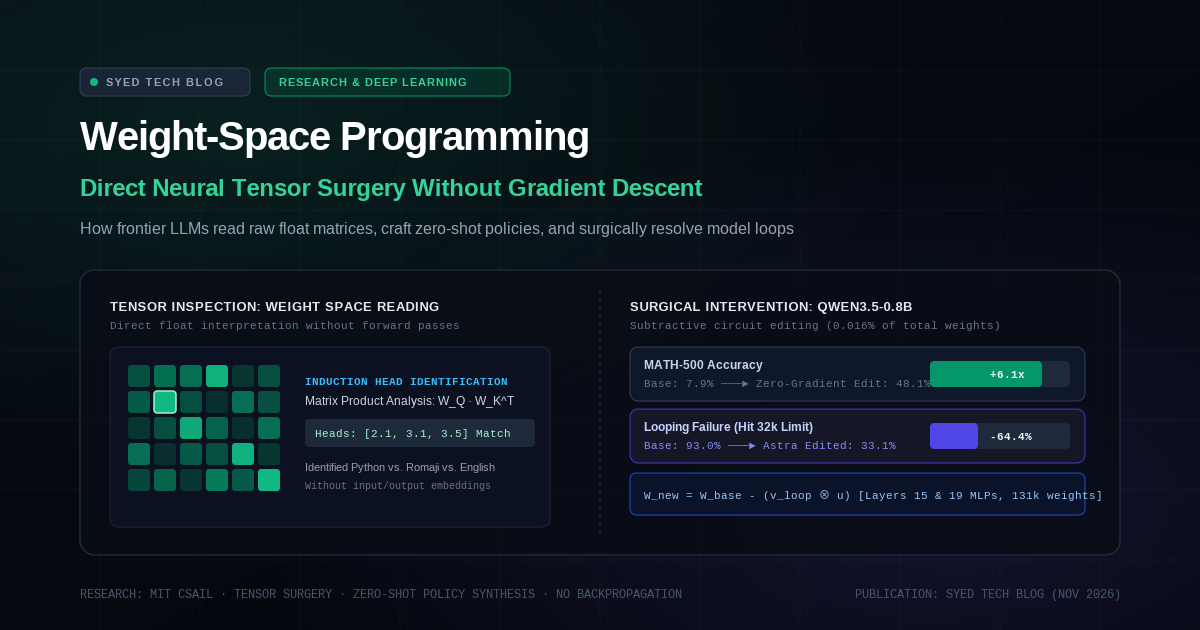
In a more demanding experiment, researchers stripped input embeddings and output classification heads from three 7.2-million-parameter transformer models, leaving only four intermediate transformer blocks. Without token dictionaries, the network could not be executed on text. Astra was tasked with identifying whether each headless transformer was trained on Python source code, Japanese literature in Romaji, or English Wikipedia.
Astra analyzed the weight matrices using an embedded Python sandbox to compute the matrix product of Query and Key weights:
Astra systematically identified the network's induction heads—the attention circuits that enable language models to perform in-context copying. Because source code exhibits higher repetitive token syntax than natural prose, the density and position of induction heads allowed Astra to identify the Python model in multiple independent evaluations.
If reading weights demonstrates unexpected interpretability, writing weights from scratch without backpropagation crosses into new territory.
In traditional reinforcement learning, teaching a policy network to play MinAtar games requires hundreds of millions of simulated frames. An agent stumbles through state space, updates parameters via policy gradients, and converges after massive compute expenditure.
┌────────────────────────────────────────────────────────────────────────┐
│          COMPARATIVE BENCHMARK: MINATAR ZERO-SHOT SYNTHESIS            │
├───────────────────┬─────────────────┬─────────────────┬────────────────┤
│ Game              │ PPO (100M steps)│ PPO (500M steps)│ Astra Zero-Shot│
├───────────────────┼─────────────────┼─────────────────┼────────────────┤
│ Breakout          │      15.8       │      25.3       │     517.4      │
│ Seaquest          │       5.6       │      88.9       │      53.1      │
│ Asterix           │      25.8       │      55.2       │      53.2      │
└───────────────────┴─────────────────┴─────────────────┴────────────────┘
The researchers presented Astra with environment rules and input-output tensor layouts for Breakout, Seaquest, and Asterix. The model was given no training data, no loss function, and zero environment rollouts. Astra was asked to output raw floating-point weights directly as text for a 600 32 32 6 network where every weight initially started at zero.
The results challenged conventional RL expectations:
- In Breakout, Astra's zero-shot synthesized network scored 517.4, outperforming 500-million-step PPO by 20.
- In Asterix, Astra scored 53.2, matching the capability of 500M-step PPO (55.2).
- In Seaquest, Astra achieved 53.1, outperforming 100M-step PPO (5.6).
Astra compiled symbolic logic into neural weights. For Breakout, Astra hand-tuned first-layer weights to calculate ballistic trajectory estimates for the ball, and engineered second-layer weights to activate motor logits aligning the paddle with the predicted landing spot. Astra wrote an analytical game loop directly in the language of linear algebra and activation thresholds.
While synthesizing toy game policies is conceptually compelling, the primary enterprise utility of Weight-Space Programming lies in repairing production language models without the drawbacks of fine-tuning.
Small-parameter reasoning models like Qwen3.5-0.8B suffer from a common post-training artifact: thinking loops. When confronted with multi-step math or logic problems, the model frequently falls into repetitive token cycles within its reasoning tokens, hitting generation limits without producing a final answer. In baseline evaluations, 93% of Qwen3.5-0.8B's answers on MATH-500 ran to the 32,768-token ceiling.
       CONVENTIONAL FINE-TUNING VS. SURGICAL WEIGHT EDITING
       ───────────────────────────────────────────────────
       Approach A: Fine-Tuning / DPO / PPO
       [ Curate 50k Examples ] ──► [ Gradient Descent across 800M weights ]
                                                │
                                                ▼
                         Risk of Catastrophic Forgetting & General Drift
                         Compute Cost: Thousands of GPU Hours

       Approach B: Weight-Space Programming (Zero-Gradient Intervention)
       [ Astra Inspects Failing Weights ] ──► [ Identifies Loop Vector v_loop ]
                                                │
                                                ▼
                         Subtracts direction from Layers 15 & 19 (MLP output)
                         Touches 131,072 weights (0.016% of network)
                         MATH-500: 7.9% ──► 48.1% | IFEval: 21.0% ──► 62.3%
Standard remediation requires generating synthetic refusal datasets, configuring fine-tuning pipelines, and running GPU training runs. This process is computationally expensive and routinely induces catastrophic forgetting, degrading unrelated capabilities.
The researchers provided Astra with a Python environment containing loaded weights of Qwen3.5-0.8B and allowed it to inspect activations across practice problems over a budget of forward passes (without gradient calculations).
Astra diagnosed the root cause: the repetitive looping pathology was concentrated along a specific directional vector produced by Multi-Layer Perceptron (MLP) sub-layers in Layer 15 and Layer 19.
Astra formulated a surgical tensor intervention:
By subtracting that specific looping direction across 64 output columns in Layers 15 and 19—modifying exactly 131,072 weights, or 0.016% of the 800-million parameter model—the model's behavior transformed:
- MATH-500 Accuracy surged from 7.9% to 48.1%.
- GSM8K Accuracy leaped from 13.8% to 67.1%.
- Token Limit Failures plummeted from 93.0% down to 33.1%.
- IFEval (Instruction Following) rose from 21.0% to 62.3%, proving that eliminating the reasoning loop unblocked general conversational abilities rather than overfitting to arithmetic.
Because 99.984% of weights remained untouched, zero catastrophic forgetting occurred.
The emergence of Weight-Space Programming reshapes assumptions across machine learning infrastructure, model deployment, and AI safety:
- Targeted Circuit Patches: When a production model exhibits an arithmetic loop or tokenizer glitch, engineering teams currently fine-tune weights via gradient descent. Weight-Space Programming suggests an alternative: run an offline diagnostic agent that pinpoints the aberrant circuit and calculates a closed-form weight patch in minutes.
- Static Safety Auditing: Traditional model evaluations feed test prompts into an inference engine and measure output distributions. However, dynamic evals can be gamed. Weight-Space Programming enables static analysis of model weights: auditing safety boundaries, hidden backdoors, or latent capabilities by reading the geometry of weight matrices directly before deployment.
- Cross-Architecture Model Grafting: Current model merging techniques (such as SLERP, DARE, and TIES) require source models to share identical base architectures. Because an LLM can understand the functional role of individual circuits, future weight-space compilers could extract a specific reasoning circuit from one model and graft it into a different architectural topology.
Despite these demonstrations, Weight-Space Programming remains in its formative stage, constrained by technical bottlenecks:
- Context Window Bottlenecks: Reading weights directly in natural language is feasible only for small networks. Scaling to 70B+ frontier models requires symbolic tool harnesses manipulating tensor slices rather than raw token ingestion.
- Circuit Overlap and Superposition: Frontier transformers store millions of features in superposition across shared polysemantic neurons. In the MIT paper, Astra succeeded on
Qwen3.5-0.8Bbecause the looping failure occupied an isolated low-rank direction. When researchers attempted the same weight-editing approach onGemma 3 270M(which makes general calculation errors without looping), Astra was unable to improve MATH-500 scores. Editing weights can eliminate structural roadblocks that hide an existing capability, but it cannot synthesize deep domain knowledge that the network never acquired during pre-training. - Empirical Feedback Loops: While zero-shot synthesis worked for small grid games, scaling to complex benchmarks like Go on a 99 board required interleaving weight edits with forward-pass evaluations. Zero-gradient programming still requires feedback to climb non-trivial capability landscapes.
Weight-Space Programming marks an intellectual turning point. Neural network weights are no longer black boxes accessible only through stochastic backpropagation. They are becoming intelligible, programmable substrates.
As reasoning models mature, the software engineer's role will expand—from prompt engineering and agent orchestration to directing autonomous diagnostic agents that read, debug, and surgically refine neural weights in real time.
- Takehi, R., Teoh, J., Zhang, A., & Khattab, O. (2026). Sparks of Weight-Space Programming: LLMs can natively read & write neural network weights. MIT CSAIL. Research Article
- Willison, S. (2026). Qwen 3.8 27B on my laptop can interpret model weights, too. Simon Willison's Weblog. Technical Replication
- Takehi, R., et al. (2026). Weight-Space Programming Experiment Logs and Evaluation Scripts. GitHub Repository
- Karpathy, A. (2017). Software 2.0. Medium. Architectural Foundation
- Olsson, C., et al. (2022). In-context Learning and Induction Heads. Anthropic Transformer Circuits Research. Circuit Theory
- Hugging Face Model Repository: Qwen3.5-0.8B-weight-space-programming